Set a rejected shear blade on the bench and look along the cutting line. If the edge has not chipped but has quietly rounded or folded over, the hardness reading is usually fine. What ran out was the ability to carry load. Most buyers spec HRC and stop there, but HRC measures resistance to a dent or a scratch, not the pressure the edge can take before it permanently moves. How much compressive strength a shear blade edge needs before it rolls over is a separate number in MPa, it climbs with hardness and alloy content, and it decides whether a blade holds its geometry on thick or high-strength stock. Spec it alongside HRC and impact energy, not instead of them.
On published D2 data, compressive yield strength runs from about 1,650 MPa at 50 HRC to 2,150 MPa at 60 HRC and 2,200 MPa at 62 HRC. A third more load-carrying capacity for twelve HRC points — and it is the same range where impact toughness falls away, which is why you cannot simply keep hardening. On a mill line cutting heavy sections, steel mill shear blade edge load is often the number that matters more than one more point of HRC.
Key Takeaways
- Hardness is not strength. HRC is indentation resistance; compressive yield strength is the load, in MPa, at which the edge starts to deform for good.
- D2 compressive yield: about 1,650 MPa at 50 HRC, 1,900 MPa at 55 HRC, 2,150 MPa at 60 HRC, 2,200 MPa at 62 HRC (published datasheet values).
- Alloy content moves it too: on one relative scale, H13 sits at 1.7, D2 at 2.8, M2 at 3.2 and PM 10V at 3.4 for compressive strength.
- Carbide wins on compression (4,000–6,000 MPa) but bends poorly — transverse rupture strength is only about 1,400–2,800 MPa.
- A rolled edge is a compression problem; a chipped edge is a toughness problem. Different numbers, different fixes.
What Does Compressive Strength Actually Measure on a Blade?
Three numbers get called "strength" and they are not the same thing. What compressive yield strength means for shear blade steel is the stress at which the edge takes a permanent set, usually quoted at a 0.2% offset. Ultimate compressive strength is where it finally crushes — for D2 that is nearer 2,750–3,000 MPa, well above the yield figure. Transverse rupture strength measures bending, which matters on a thin supported edge. The table below is a single published comparison of relative values, all on the same scale, not MPa:
| Grade | Hardness (HRC) | Relative compressive strength | Wear index (same scale) | Toughness index (same scale) |
|---|---|---|---|---|
| H13 | 54 | 1.7 | 1.0 | 8.5 |
| S7 | 57 | 2.2 | 1.4 | 7.3 |
| A2 | 62 | 2.7 | 3.1 | 3.5 |
| PM 3V | 60 | 2.7 | 3.9 | 6.0 |
| D2 / Cr12MoV | 61 | 2.8 | 4.3 | 1.8 |
| M2 | 62 | 3.2 | 4.7 | 2.2 |
| PM M4 | 62 | 3.6 | 5.9 | 2.6 |
| PM 10V | 63 | 3.4 | 8.4 | 1.8 |
Read this compressive strength comparison for D2 H13 and M2 blades as a ranking, not a specification: the numbers are relative, and a different mill will publish a different scale. The pattern is the useful part. Molybdenum, tungsten and carbide volume push compression up; toughness goes the other way. That is why a die or punch that sees a slow, heavy squeeze is specified differently from one that takes a hammer blow — briquetting punch compression rating is mostly about steady load, while a demolition blade is about shock.
When Does a 60 HRC Edge Start to Deform?
Why a 60 HRC blade edge still deforms under load is usually a story about temper, section thickness and heat. Hardness buys compressive strength only up to a point, and a hot edge loses both. These are published compressive yield values for D2 at the stated hardness, with elastic modulus around 190–210 GPa for the grade — indicative, so confirm against your own heat-treatment route:
| D2 hardness (HRC) | Compressive yield strength (MPa) | What it means on the shear |
|---|---|---|
| 50 | 1,650 | Soft, tough, rolls on thick high-strength stock |
| 55 | 1,900 | Workable compromise on mixed scrap with shock |
| 60 | 2,150 | Standard cold-shear target, holds geometry well |
| 62 | 2,200 | Small gain, much less tolerance for impact |
Other mill datasheets put 60 HRC D2 in the same 2,000–2,200 MPa band, so treat D2 compressive yield strength at 50 to 62 HRC as a range rather than a single certified value. The last two HRC points buy only about 50 MPa — poor value if the blade also sees tramp metal. Tungsten carbide is a different case: published ranges run around 4,000–6,000 MPa in compression but only about 1,400–2,800 MPa in transverse rupture, which is why it survives a squeeze and fails a bend. On a baler, where wire abrasion and a sudden tight bundle arrive together, baler blade edge deformation is usually fixed by edge support and a realistic HRC band, not by chasing the highest compressive number.
Which Number Should You Check When an Edge Deforms?
Start with the shape of the failure, not with the grade chart. Which strength number to check when a blade edge rolls over depends on whether the steel moved, cracked or simply wore away:
| What you see on the edge | Number that ran out | Most likely driver | First move |
|---|---|---|---|
| Rounded or folded over, no fracture face | Compressive yield strength (MPa) | Section too thick, feed strength high, edge running hot | Add 2 HRC, strengthen the bevel, check clearance |
| Chipped, bright fresh fracture faces | Impact energy (J) | Tramp metal, shock, clearance too tight | Temper back 2–3 HRC or move to a shock grade |
| Smooth, blunt, evenly worn | Wear resistance (relative / carbide volume) | Abrasive feed, scale, filled board | Higher-carbide grade, PM grade or coating |
| Blade bent, bolt holes ovalised | Body yield strength / section stiffness | Overload, poor seating, worn support faces | Check the holder steel and the mounting, not the edge |
| Edge soft after a hot run | Temper resistance / hot hardness | Section above the tempering range | Hot-work grade and better cooling |
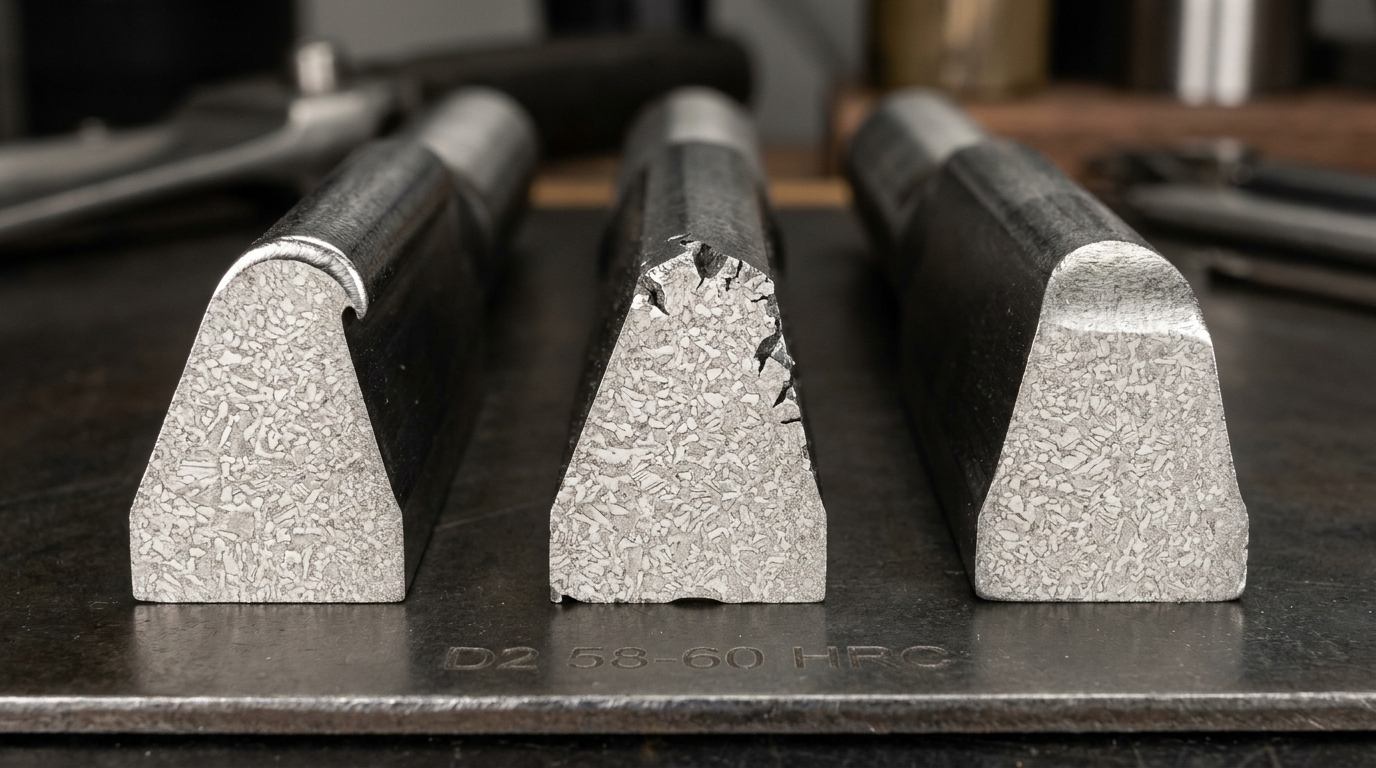
Use this shear blade edge deformation diagnosis chart as a first pass, not a lab report. Most real failures are a mix — a rounded edge with a few chips usually means compression was marginal and shock finished the job. Record the section thickness, the feed grade and the edge temperature with the failed blade; those three let a supplier tell you which number to raise instead of just offering a harder steel.
FAQ
What is compressive strength in a shear blade?
It is the load per unit area, in MPa, that the cutting edge can carry before it permanently deforms. The figure normally quoted for tool steel is compressive yield strength at a 0.2% offset — for D2 at 60 HRC that is about 2,150 MPa. Ultimate compressive strength, where the steel actually crushes, is higher (roughly 2,750–3,000 MPa), and bending strength is a separate transverse rupture test again. Ask which one a supplier means.
Why does a hard blade edge still roll over?
Because the local contact stress exceeded the steel's compressive yield strength, or because a hot edge lost hardness during the cut. HRC is measured cold on a clean surface; a blade cutting thick high-strength stock sees both higher load and higher temperature. A rounded edge with no fracture face is the signature. Adding 2 HRC, strengthening the bevel or moving to a grade with more molybdenum and tungsten are the usual fixes.
Is 2,150 MPa enough for cutting high-strength steel?
Often yes for clean plate at moderate thickness, but there is no universal threshold. Contact stress at the edge depends on section thickness, edge angle, clearance and the strength of the work material, not just on the blade number. If the edge rolls on high-strength stock, treat 2,150 MPa as a starting point: check the geometry and clearance first, then move up in hardness or to a PM grade. Do not size a blade from a single MPa figure.
Does tempering back a blade reduce its compressive strength?
Yes. On the published D2 series, dropping from 62 HRC to 50 HRC cuts compressive yield strength from about 2,200 MPa to 1,650 MPa, roughly a quarter. What you buy back is toughness and shock tolerance. That is the real trade behind every "temper it back" recommendation: you are exchanging load-carrying capacity for resistance to cracking, and the right balance depends on whether your blade fails by rolling or by chipping.
Should I ask for a compressive strength figure on a blade certificate?
Rarely as an acceptance value. Compressive testing is destructive and mills quote typical values, not batch measurements, so a certificate number usually comes from a datasheet. What is worth asking for is the grade, the actual HRC readings, the heat-treatment route and the heat number — those pin down where on the 1,650–2,200 MPa band your blade actually sits. Use compressive strength to choose the grade, and HRC plus hardness uniformity to check the delivered batch.
A blade edge has to do three things at once: resist abrasion, survive a shock and carry the load without moving. HRC only describes the first part of that picture. Blade steel specification beyond hardness means putting compressive yield strength and impact energy on the same enquiry as the grade and the temper, then matching them to the thickest, strongest material your shear will ever see. Bring the section thickness, the feed grade and a photo of the failed edge when you ask for a quote — that tells a supplier which number to raise. See the full range at GOOD-KNIFE or send us your drawing for a like-for-like recommendation.