Shear blade gap — also called cutting clearance — is the running space between the moving blade and the fixed bed or anvil. Set it to 5–10% of the material thickness you cut most often. On a 6 mm (0.24 in) mild-steel plate that means a gap of 0.4–0.6 mm (0.016–0.024 in). Too tight and the blade drags, overheats and galls; too wide and you get a heavy burr and a rolled, fractured edge. This 2026 field guide gives the exact gap in millimetres for every common plate thickness, the adjustment for each material, and a step-by-step setting procedure you can run with a feeler gauge. Bottom line: gap = 5–10% of thickness — use the tight end (5–7%) for thin and soft stock, the wide end (8–10%) for thick, hard or abrasive stock — and re-check it every shift on a busy line. GOOD-KNIFE ships every steel mill shear blade with a measured clearance baseline so the setting starts from a known number, not a guess.
Key Takeaways
- Rule of thumb: set the blade gap to 5–10% of material thickness — 0.4–0.6 mm on 6 mm plate, 1.0–1.6 mm on 16 mm plate.
- Material shifts the number: soft metals (aluminium, copper) want 5–8%; gummy stainless and abrasive AR steel want 8–12%; non-metals up to 15%.
- Too tight (<5%) → drag, heat, galling and shiny material transfer on the blade.
- Too wide (>10%) → heavy burr, rolled or fractured edge, fold-over on thick stock.
- Re-check the gap every shift on high-volume lines and after every blade change or regrind.
What Is the Blade Gap on a Shear?
The gap is the distance the moving (upper) blade sits away from the fixed (lower) blade or anvil when it is at rest against the stop. It is not a property of the blade itself — it is a machine setting, adjusted with shims, eccentric bolts, or a hydraulic ram. During the cut the two blades shear the material like a pair of scissors; the gap controls how much the stock is allowed to stretch versus part cleanly. The standard formula is simple:
Gap (mm) = Material thickness (mm) × 0.05 to 0.10
A shear is designed for a thickness range, but the gap must be re-set whenever the stock thickness changes by more than about 30%. Leaving one gap for everything is the most common — and most expensive — mistake on a recycling or plate line.
What Gap Should You Set for Each Plate Thickness?
These are the practical starting gaps for mild and low-carbon steel, measured between the blade faces. Tighten toward the low end for thin, soft stock; open toward the high end for thick or abrasive stock:
| Material thickness | Recommended gap | Gap as % of thickness |
|---|---|---|
| 1.5 mm (0.06 in) | 0.10–0.15 mm | 7% |
| 3 mm (0.12 in) | 0.20–0.30 mm | 8% |
| 6 mm (0.24 in) | 0.40–0.60 mm | 8% |
| 10 mm (0.39 in) | 0.60–1.00 mm | 9% |
| 16 mm (0.63 in) | 1.00–1.60 mm | 9% |
| 25 mm (1.00 in) | 1.50–2.50 mm | 10% |
For lines that cut a single thickness all day — typical on plate and structural mills — lock the gap to that one value and verify it against a certificate. Thick-section steel mill shear blades are the least forgiving: a 0.2 mm error on 25 mm plate shows up immediately as a torn edge.
Does the Material Change the Gap?
Yes. Ductility and work-hardening change how the stock stretches in the shear zone, so the same thickness wants a different gap by material. Mixed scrap lines should set to the predominant feed and tolerate the rest:
| Material | Recommended gap (% of thickness) | Why |
|---|---|---|
| Aluminium, copper, brass | 5–8% | Soft, low springback — narrow gap gives a clean edge without burr |
| Mild / low-carbon steel | 7–10% | Standard baseline, moderate ductility |
| Stainless 304 / 316 | 8–12% | Gummy and work-hardening — wider gap stops drag and galling |
| AR / Hardox / high-strength | 8–12% | Abrasive — wider gap reduces edge shock and micro-chipping |
| Rubber, plastic, non-metal | 10–15% | Elastic springback needs extra clearance to part cleanly |
On a scrap gantry shear the feed is mixed and dirty, so most operators run the gap at the high end (9–12%) to survive rebar, plate and the occasional hardened piece without resetting between loads.
What Happens If the Gap Is Wrong?
The cut face tells you the gap at a glance. Match the symptom to the fix before you touch the blade steel:
| Symptom on the cut face | Likely gap cause | Fix |
|---|---|---|
| Heavy burr, rolled or fractured edge | Gap too wide (>10%) | Close to 5–10% of thickness |
| Blade drags, overheats, shiny transfer | Gap too tight (<5%) | Open to 5–10%; check lubrication |
| Burr only on one end of the cut | One side out of adjustment | Level the bed; equal shims both ends |
| Premature edge chipping | Gap too tight + hard grade | Widen gap and/or use tougher grade |
| Material folds over, will not part | Gap far too wide | Reset to spec; verify thickness range |
How Do You Measure and Set the Gap?
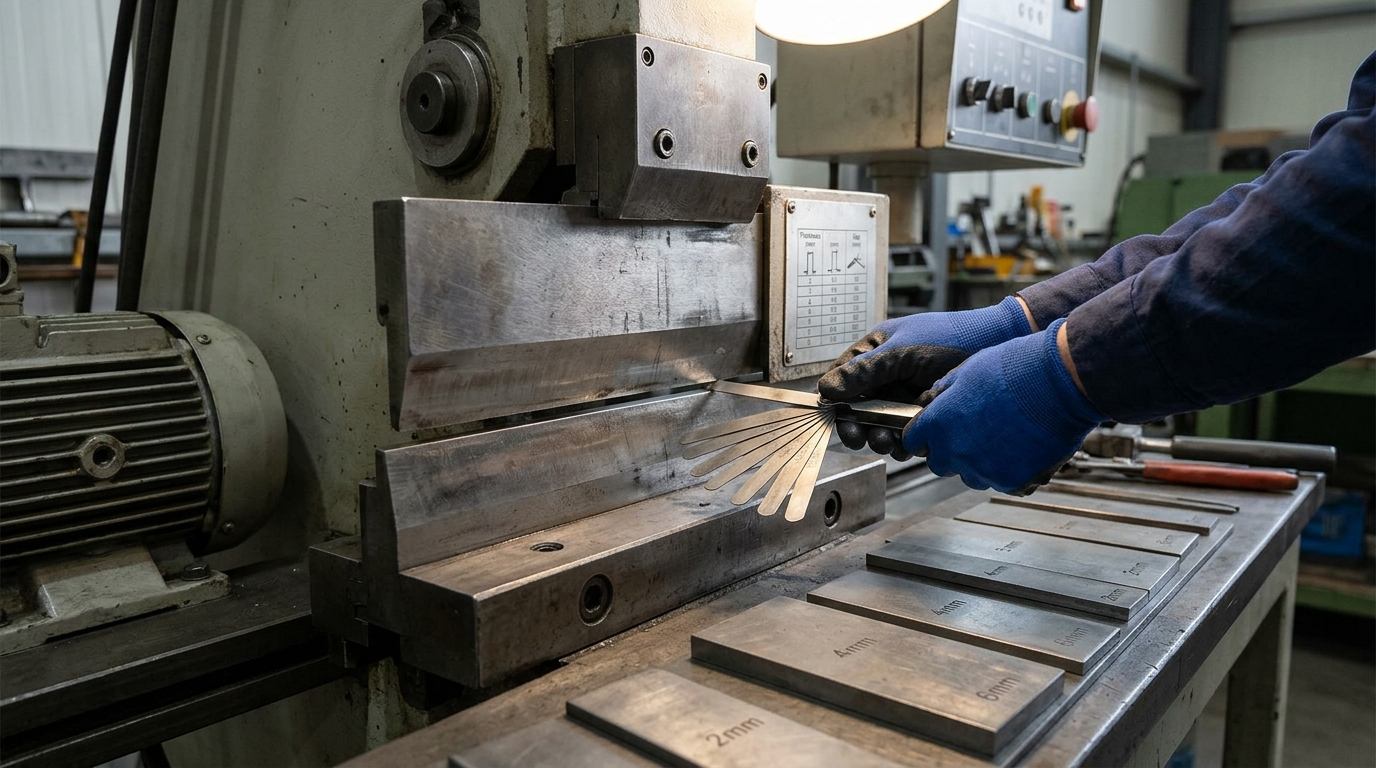
You need a feeler gauge and shim stock — no special tooling. Use the gauge sizes below as your setting targets:
| Target gap | Feeler / shim to use |
|---|---|
| 0.10–0.30 mm | 0.05 mm and 0.10 mm feeler blades |
| 0.40–0.60 mm | 0.20 mm shim + 0.05 mm feeler |
| 0.60–1.00 mm | 0.50 mm shim + 0.10 mm feeler |
| 1.00–2.50 mm | 1.00 / 1.50 / 2.00 mm shim stock |
Step-by-step:
- Lock out and power down the shear; lower the upper blade to the stop.
- Insert the feeler gauge (equal to target gap) between the blades at both ends and the centre.
- Adjust shims or eccentric bolts until the gauge drags with equal resistance at all three points — tolerance ±0.02–0.05 mm across the length.
- Torque the blade bolts to the manufacturer's specification, typically 80–120 N·m for M16–M20 blade bolts.
- Cut a test piece and measure the burr; fine-tune by ±0.05 mm until the edge is clean.
Rotary machines follow the same rule on a different axis: a shredder blade needs the rotor-to-bed clearance held to a tight band too, or the hooks dull and the throughput drops. The principle — small, verified, re-checked clearance — is identical.
How Often Should You Recheck the Gap?
Clearance drifts from bolt relaxation, shim wear and blade regrinding, so it is not a set-and-forget value. On a high-volume line, re-verify the gap every shift; on a moderate line, every 50–100 tons cut; and always after a blade change or regrind, because grinding changes the edge radius and flatness and can shift the effective clearance by 0.05–0.10 mm. A 60-second feeler check at the start of each shift prevents hours of burr reclaim and edge damage later.
FAQ
What is the rule of thumb for shear blade clearance?
Set the gap to 5–10% of the material thickness you cut most: about 0.4–0.6 mm on 6 mm plate and 1.0–1.6 mm on 16 mm plate. Use the low end (5–7%) for thin and soft stock, the high end (8–10%) for thick, hard or abrasive stock.
Can I use one gap for all material thicknesses?
No. Re-set the gap whenever the stock thickness changes by more than about 30%. Some modern shears adjust automatically, but most manual and scrap lines use shims and need a feeler-gauge check at each changeover.
How do I know if my gap is too tight or too wide?
A heavy burr or rolled, fractured edge means the gap is too wide; the blade dragging, overheating or showing shiny material transfer means it is too tight. A burr only at one end points to one side being out of adjustment.
Does the gap change after regrinding the blade?
Yes. Regrinding changes the edge radius and flatness, which can shift the effective clearance by 0.05–0.10 mm. Always re-verify the gap after every regrind, not just after a full blade replacement.
Do carbide blades need a different gap?
The same 5–10% rule applies, but carbide is brittle, so keep the gap within specification and avoid shock loads. Many carbide applications run the tighter 6–8% band for a cleaner cut and longer edge life.
Setting the right blade gap is the cheapest performance gain on any shear line — it costs nothing but a feeler gauge and five minutes. Match the gap to your thickest regular stock, verify it after every blade change, and keep a measured certificate on file. For blades built to a verified baseline, browse the full range at GOOD-KNIFE, or send your plate thickness and material and we will recommend the matched gap and blade spec.