Most briquetting lines don’t fail on the press — they fail on the die. Pick the wrong hole size or compression ratio and you get bridging in the chamber, a soft briquette that falls apart, or a die that cracks within a week. We’ve watched plants run a new die for three weeks, then blame the hydraulic unit when density drops; nine times out of ten it’s the geometry, not the machine. Match the briquetting die and punch to your scrap — fines, chips, or mixed — then track tons through it so you recondition before density slips. Get those two right and a die runs its full life instead of half of it.
Key Takeaways
- Scrap decides geometry. Long steel turnings want a bigger hole and lower ratio; fine cast-iron dust wants the opposite — match or you bridge.
- Compression ratio runs 5:1 to 12:1. Light, springy scrap (aluminium, copper) needs the high end; dense scrap needs less.
- Die life is set by abrasiveness. Cast iron wears a die out in 400–900 t; copper can run 2,000–4,000 t.
- Recondition 2–3 times, then replace. Once the bore is more than 0.5 mm over, density won’t come back.
- Log tons per die — that single number predicts your reorder date better than any calendar.
What Does a Briquetting Die Actually Do?
The die is the chamber that squeezes loose scrap into a solid puck. Two numbers matter more than anything else:
- Hole diameter — typically 30–120 mm. Bigger takes bulky turnings; smaller suits fine dust but clogs faster on long swarf.
- Compression ratio — the volume of loose scrap versus the finished briquette, usually 5:1 to 12:1. Too low and the puck is soft; too high and the press strains and the die heats.
- The punch is what drives the scrap in and holds pressure; its shape and stroke set your throughput more than people expect.
How Do You Match Die Geometry to Your Scrap?
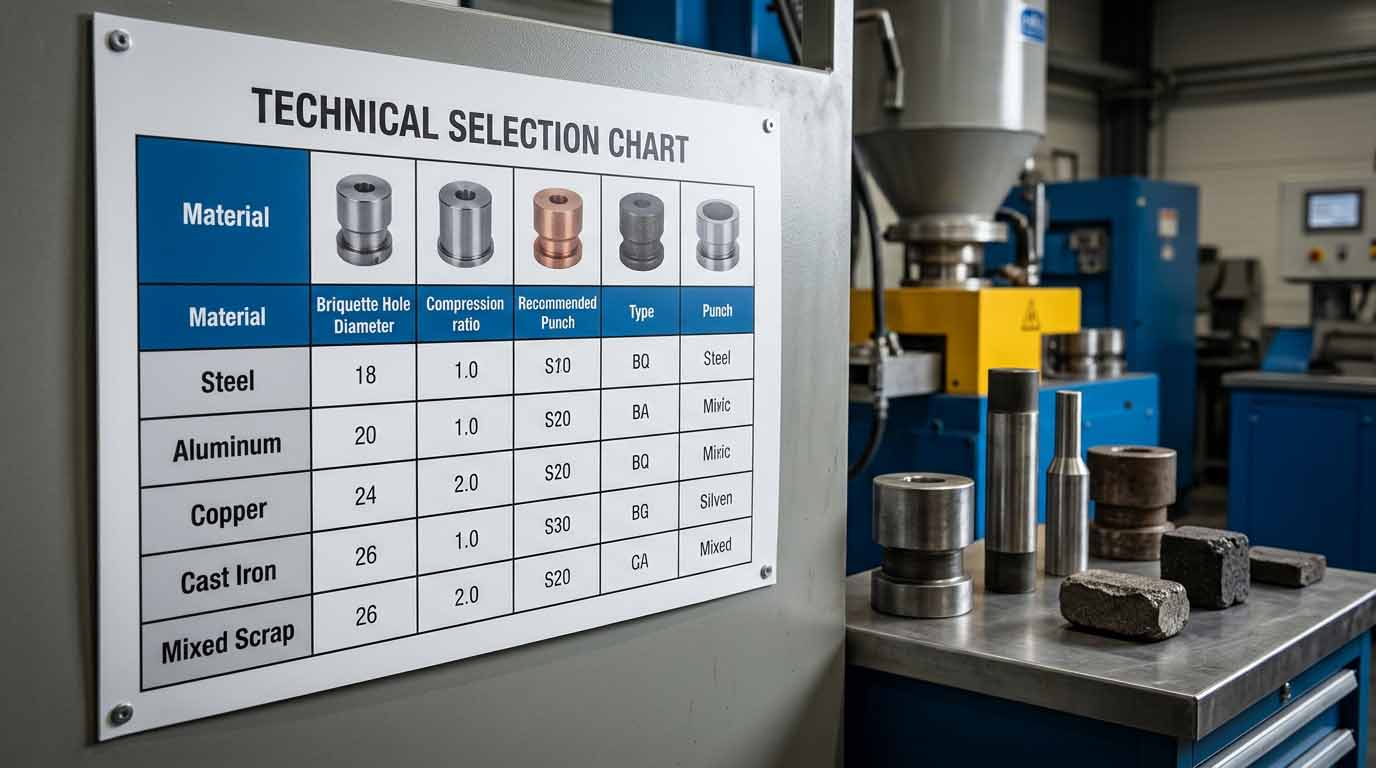
Start from what lands in the hopper. These are the settings we spec most often:
| Scrap type | Hole dia (mm) | Compression ratio | Watch out for |
|---|---|---|---|
| Steel turnings (long) | 50–90 | 6:1–9:1 | Bridging — pre-crush helps |
| Aluminium chips | 40–70 | 7:1–10:1 | Spring-back; aim high density |
| Copper / brass chips | 35–60 | 8:1–12:1 | Heat build-up at high ratio |
| Cast iron fines | 30–55 | 5:1–8:1 | Abrasive — short die life |
| Mixed MSW / biomass | 60–120 | 4:1–7:1 | Low density target |
If you run more than one scrap, the briquetting mold geometry has to suit the worstdominant feed, not the average — a die tuned for aluminium will bridge on steel turnings the moment they show up in the hopper.
Which Punch Type Fits Your Press?
The punch decides how fast and how consistently you fill the die:
| Punch type | Best for | Typical life (strokes) |
|---|---|---|
| Single-acting | Simple lines, lower pressure | 1–3 million |
| Multi-hole ring + multi-punch | High throughput, uniform scrap | 5–10 million |
| Variable / servo punch | Mixed or varying scrap | 3–6 million |
How Long Should a Briquetting Die Last?
Life is really set by how abrasive the feed is, not by the steel grade. Rough figures from the floor:
| Material | Tons through die | First sign to recondition |
|---|---|---|
| Steel turnings | 800–1,500 t | Density drop > 8% |
| Aluminium chips | 1,500–3,000 t | Surface streaking |
| Copper / brass | 2,000–4,000 t | Press amps creep up |
| Cast iron fines | 400–900 t | Visible bore scoring |
| Stainless | 1,000–2,000 t | Work-hardening in bore |
When Do You Recondition vs Replace a Die?
A die is not done when it first scores — but it has a hard limit. The call is usually clear:
- Recondition (regrind + re-hone the bore): scoring is shallow, bore is within +0.3 mm of spec, and density recovers on test. You get 2–3 passes before the wall is too thin.
- Replace: any crack, bore over +0.5 mm, lost compression ratio, or density that won’t come back after reconditioning.
- Keep a baler shear blade scrap log beside the die log — when the baler drops fines consistency, the die sees a different feed and its life shifts with it.
FAQ
How do you choose the right briquetting die for your scrap?
Match the hole diameter and compression ratio to your dominant feed: long steel turnings want a 50–90 mm hole at 6:1–9:1, fine cast-iron dust wants 30–55 mm at 5:1–8:1, and springy aluminium or copper wants the high end of the ratio (7:1–12:1) for density. Tune for the worst feed in the mix, not the average.
What compression ratio should a briquetting die use?
Most lines run 5:1 to 12:1. Light, springy scrap (aluminium, copper) needs the high end to hold a dense puck; dense or pre-compacted scrap needs less, and pushing the ratio too high just heats the die and strains the press. Start at the low end of the range for your material and raise it only if density is soft.
How many times can you regrind a briquetting die?
Usually 2–3 times. You can regrind and re-hone the bore as long as scoring is shallow and the bore stays within +0.3 mm of spec with density recovering on test. Past +0.5 mm, or any crack, the wall is too thin and the die should be replaced — reconditioning won’t bring density back.
Why does my briquette density drop even with a new die?
Nine times out of ten it’s feed, not the die. Inconsistent fines from upstream equipment, moisture swings, or scrap that bridges in the chamber all drop density. Log tons through each die and check the feed before blaming the tool — a die that tested dense on Monday usually still is on Friday.
Which punch type gives the longest life?
A multi-hole ring die with a multi-punch set lasts longest — typically 5–10 million strokes on uniform scrap — because load spreads across punches. Single-acting punches run 1–3 million; variable servo punches 3–6 million but suit mixed feeds. Pick by throughput and how consistent your scrap is, not by headline life alone.
The die is the cheapest part of the line and the one that decides whether your briquettes hold together — so spec it from your scrap, not from a catalogue number. Match hole size and compression ratio to the worst feed you run, pick the punch for your throughput, and log tons so you recondition on schedule. GOOD-KNIFE supplies briquetting dies and punches cut to your scrap profile and a die-log template to track life — see the full range at GOOD-KNIFE or send us your scrap type to spec the first one.