Choosing the right shear blade for your machine starts with two facts only you control: what you cut and what you cut it on. Match the steel grade, hardness, edge angle, and clearance to those two, and a D2 or M2 blade will run 30–60% longer than a generic catalog item on the same job. Get it wrong and the best steel in the world fails early. For mild-steel plate, that usually means D2 at 58–62 HRC with a 40–55° edge and 5–10% clearance; for gummy 304 stainless it means a tougher M2 or D2 with a DLC coating at 60–63 HRC to stop work-hardening and galling; for abrasive AR or cast scrap it means M2, H13, or even tungsten carbide at 62–65 HRC. Build the spec from your material and machine type using the tables below, then confirm it against a measured drawing — a blade matched on paper before order is the cheapest performance gain on the line. GOOD-KNIFE engineers every steel mill shear blade to the customer's drawn profile, hardness, and clearance so the fit is right the first time.
Key Takeaways
- Match grade to material: D2 for balanced mild-steel and scrap work; M2 or H13 for shock and abrasion; carbide only where wear — not impact — limits life.
- Hardness band: most jobs sit at 58–62 HRC; push to 62–65 HRC for abrasive feeds, drop to 56–58 HRC for high-shock mobile shears.
- Edge angle tracks the feed: 30–45° for thin-to-medium metal, 45–60° for abrasive or thick section.
- Clearance is set by machine and thickness: 5–10% for plate shears, 8–12% for scrap and mobile shears.
- A wrong match can cut blade life by 30–60% even with premium steel — selection matters more than brand.
What Information Do You Need Before Choosing a Blade?
Before you pick a grade or angle, write down four things — they are the inputs every table below uses:
- The material you cut — mild steel, stainless 304/316, AR/Hardox, cast iron, tire wire, aluminium, mixed scrap.
- The machine type — gantry/scrap shear, baler shear, plate mill shear, mobile demolition shear, shredder rotor, briquetting press.
- Section thickness and cut length — these set the required clearance and edge angle.
- The duty cycle — tons per shift, abrasives present, and stop frequency tell you whether to spend on a tougher grade or coating.
Which Blade Steel Grade Matches Your Material?
This is the first and most important decision — the grade sets wear and shock resistance. Use the material you cut most often as the guide:
| Material you cut | Recommended grade | Hardness (HRC) | Coating | Why this works |
|---|---|---|---|---|
| Mild / low-carbon steel | D2 (Cr12MoV) | 58–62 | Optional TiCN | Best wear–toughness balance for clean steel |
| Stainless 304 / 316 | M2 or D2 | 60–63 | DLC | Tougher grade + low friction stops work-hardening and galling |
| AR / Hardox / cast iron | M2 or H13 | 62–65 | TiCN | Hard, tough, abrasion-resistant against high-wear scrap |
| Tire / baling-wire scrap | D2 | 58–62 | DLC | Sticky and abrasive — coating prevents material build-up |
| Aluminium / copper | D2 | 58–60 | None / DLC | Soft metal — avoid built-up edge, keep a keener angle |
| Continuous heavy abrasion | Tungsten carbide | 89–93 HRA | n/a | 10–20× steel wear life where impact is low |
A shredder blade lives or dies by this table — tire and steel feeds need different grades and coatings, and running the wrong one packs the rotor and halves throughput. The grade is the single biggest lever on life.
How Does Your Machine Type Change the Blade Spec?
The same material wants a different edge and clearance on a plate shear versus a scrap shear. Match the spec to the machine, not just the feed:
| Machine type | Typical grade | HRC | Edge angle | Clearance |
|---|---|---|---|---|
| Gantry / scrap shear | D2 / H13 | 58–62 | 45–60° | 8–12% |
| Baler shear | D2 + coating | 58–62 | 40–55° | 8–10% |
| Plate / steel-mill shear | M2 / D2 | 60–63 | 40–55° | 5–10% |
| Mobile / demolition shear | M2 / H13 | 60–64 | 45–60° | 8–12% |
| Shredder rotor | D2 + DLC | 58–62 | 30–45° | 0.2–0.5 mm |
A baler shear blade is a clear example: because baling wire is high-tensile and sticky, it runs a coated D2 at 40–55° with 8–10% clearance — the same grade on a plate mill would be set up completely differently. The machine decides the geometry even when the steel is the same.
What Edge Angle and Clearance Should Each Application Use?
When the feed and machine still leave doubt, use this decision rule — it is the fastest way to avoid a costly mismatch:
| If your feed is… | Choose this |
|---|---|
| Abrasive (AR, cast iron, hardened scrap) | M2 / H13 or carbide, 62+ HRC, TiCN, 45–60° edge |
| Gummy (stainless 304 / 316) | M2 + DLC, 60–63 HRC, low-friction coating |
| Sticky (tire, plastic, mixed MSW) | D2 + DLC, 58–62 HRC, prevents build-up |
| Thin / clean (mild steel sheet) | D2, 58–60 HRC, keener 30–40° edge |
| High-shock (mobile demolition) | H13 / M2, 60–64 HRC, tougher grade over max hardness |
How Do You Build a Blade Specification Checklist?
Turn the tables into a one-page order spec. Send this to the supplier — a drawing beats a part number every time:
- Material and hardness of what you cut — e.g. mild steel 350 MPa, AR400 plate, stainless 304, tire wire.
- Machine model and mounting — shear or rotor type, bolt pattern, pocket dimensions.
- Dimensions and tolerance — length × width × thickness with ±0.01–0.02 mm, hole centres ±0.1 mm.
- Steel grade, hardness, coating — from the material table above.
- A sample blade or worn part — GOOD-KNIFE reverse-engineers profile, steel, and heat treatment and returns a measured certificate before volume.
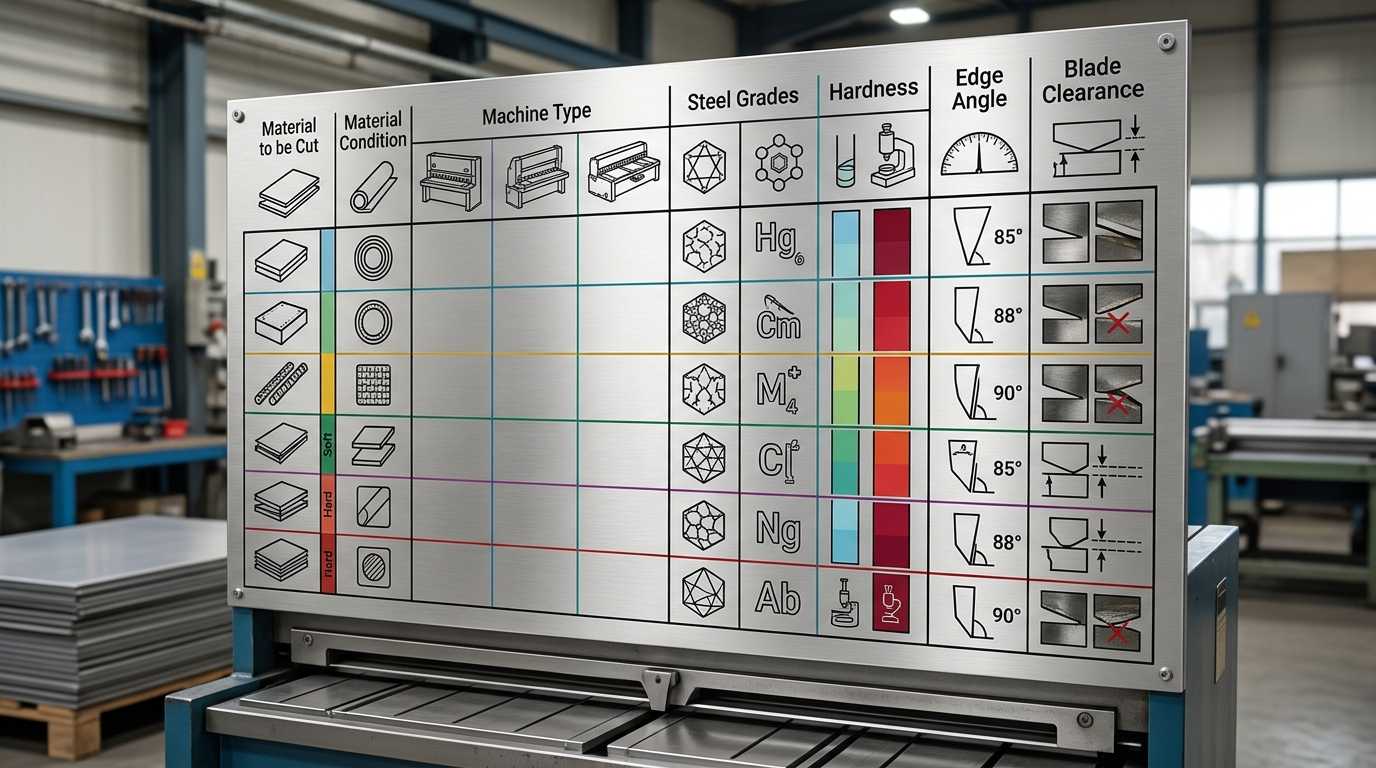
Get the grade and angle right on this sheet and the blade arrives matched; get them wrong and even a perfect heat treatment will not save the edge.
FAQ
How do you choose the right shear blade for your material?
Start from the material you cut most: D2 for balanced mild-steel and scrap work, M2 or H13 for shock and abrasion, carbide only where wear — not impact — limits life. Then set hardness (58–62 HRC for most jobs, 62–65 for abrasive feeds) and add a coating (DLC for sticky, TiCN for hard-abrasive) where the feed demands it.
Which blade steel grade is best for cutting stainless steel?
For 304 or 316 stainless, use M2 or D2 at 60–63 HRC with a DLC coating. Stainless work-hardens and galls, so you need a tougher grade than mild steel plus a low-friction coating to keep the edge cutting instead of smearing. A plain D2 blade without coating will load up and fail early on stainless.
Does the same blade fit a gantry shear and a baler shear?
Often the same steel grade, but usually a different edge angle and clearance. A baler shear fighting baling wire runs a coated D2 at 40–55° with 8–10% clearance; a gantry scrap shear runs D2 or H13 at 45–60° with 8–12% clearance. Match the geometry to the machine, not just the material.
What edge angle should a shear blade have for abrasive scrap?
Use a blunter 45–60° edge on abrasive or thick-section scrap (AR plate, cast iron, hardened scrap). A sharper angle chips on the abrasives and loses 30–60% of its life; the blunt edge carries the load without micro-chipping. Keep hardness at 62–65 HRC and add a TiCN coating.
Can a wrong blade choice really cut service life that much?
Yes. A wrong grade, angle, or clearance can shorten blade life by 30–60% even with premium D2 or M2 steel — selection matters more than the brand stamped on the side. The tables above are the cheapest insurance: spec from your material and machine before you order, not after the edge fails.
The right blade is the one matched to your material and machine on paper before it is cut. Pick the grade from your feed, the hardness and edge angle from your machine, add a coating where the scrap demands it, and confirm the whole spec against a measured drawing. Send GOOD-KNIFE your cut material, machine model, and a sample or drawing and we will engineer the blade that fits and lasts — browse the full range at GOOD-KNIFE or start with a measured sample.